


-
Address:
-
Phone: +65 8914 6529
-
Email: [email protected]

 English
Your cart
0 items
Shopping cart is empty (0 item)
English

As electrical distribution networks scale to accommodate higher amperages, panel builders are required to fabricate connections utilizing thicker, heavier-gauge copper and aluminum busbars. Fabricating clean, accurate connection points on metal plates reaching 10mm in thickness exceeds the mechanical threshold of standard workshop punchers. Attempting to process 10mm metal with under-capacity equipment results in severe frame deflection, tooling fracture, and compromised fabrication tolerances. Furthermore, reverting to thermal or mechanical drilling on such thickness generates excessive heat-affected zones and significant metallic swarf.
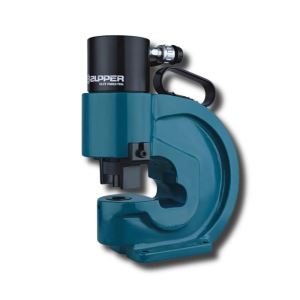
The Zupper CH-70 hydraulic hole puncher is engineered specifically to address the mechanical demands of high-thickness fabrication. Classified as a heavy-duty C-frame hydraulic press, this equipment delivers a maximum rated load capacity of 35 tons (350 KN) to execute instantaneous punching operations. It is mechanically certified for punching through copper busbars, aluminum conductors, and mild carbon steel plates up to a strict maximum thickness of 10.0 mm. By deploying the CH-70, structural steel fabricators and high-voltage switchgear manufacturers can process heavy-gauge metals efficiently while maintaining absolute compliance with strict electrical continuity and mechanical joint standards.

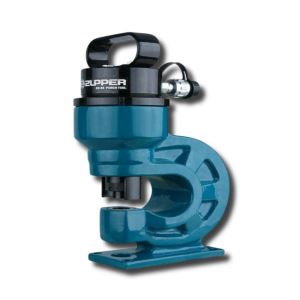
Zupper hydraulic hole puncher for 10mm steel plate CH-70
Executing a clean hole through 10mm of solid metal requires a fundamental reliance on hydraulic punching mechanics. Unlike rotary cutting methodologies that generate sustained friction, the CH-70 utilizes 35 tons of instantaneous linear force to push a hardened steel punch directly through the target material and into a precision-matched receiving die.
Processing heavy-gauge materials via punching preserves the metallurgical integrity of the busbar through the following physical mechanisms:
Zero thermal degradation: The shearing action occurs in a fraction of a second. The 10mm copper or steel workpiece remains at ambient temperature throughout the entire penetration cycle. This total bypass of thermal friction prevents localized annealing, ensuring the metal retains its original structural hardness and optimal electrical conductivity at the bolted connection node.
Die clearance optimization: Punching 10mm metal introduces the risk of material "roll-over" or tearing if the clearance between the punch and the die is incorrect. The CH-70 tooling is machined with strict diametrical clearances optimized for heavy-gauge material. This ensures a vertical, mirror-smooth shear plane across the entire 10mm depth, resulting in a hole completely devoid of raised burrs or sharp metallic edges.
Spark-free industrial compliance: The punching process generates zero sparks and zero airborne metal dust. It produces only a single, solid metallic slug per operation. This spark-free characteristic is a mandatory compliance factor for workshops adhering to strict environmental, health, and safety standards.
Generating and absorbing a 350KN continuous shear force imposes extreme kinetic stress on the structural housing of the equipment. When processing 10mm steel, the reactive forces attempting to push the upper and lower jaws apart are massive. If the frame lacks sufficient mass and rigidity, this structural deflection will cause the upper punch to strike the edge of the lower die, resulting in catastrophic tooling fragmentation.
To counteract these 35-ton reactive forces, the Zupper CH-70 utilizes a massive monolithic C-frame architecture forged from high-carbon cast steel.
Monolithic cast integrity: Utilizing a continuous casting process rather than welding separate steel plates eliminates structural weak points and internal weld-seam fatigue. The uniform density of the cast steel provides a rigid, unyielding structure that absorbs and dissipates the 350KN force linearly without measurable deformation.
Optimized unit weight: The density of this heavy-duty cast steel frame results in a net unit weight of approximately 35.0 kg. This substantial mass permanently classifies the CH-70 as a stationary workshop fabrication tool. The 35.0 kg unit weight acts as a critical engineering dampener, anchoring the tool securely to the workbench, absorbing the kinetic shock of the 10mm metal shear, and maintaining absolute concentricity between the punch and die over thousands of industrial cycles.
In high-amperage switchgear assembly, standard copper busbars frequently exceed 150mm in width to carry the necessary current. To align the connecting bolts properly and maintain safe phase-to-phase dielectric clearances, the connection holes must be punched strictly along the longitudinal centerline of the busbar.
The CH-70 accommodates these expanded dimensional requirements via its extended 110mm throat depth. This parameter defines the maximum distance from the center of the punching die to the inner back wall of the rigid C-frame. A 110mm clearance ensures that technicians can position extra-wide busbars deep into the jaw of the tool, allowing for precise center-punching on materials up to 220mm in total width. This spatial flexibility is critical for panel builders executing complex, high-capacity electrical distribution layouts.
To maximize tooling lifespan and ensure verifiable fabrication quality on 10mm metal, operators must implement the following systematic workflow:
Dimensional marking: Utilize a precision scribe or a digital layout gauge to mark the exact center-point of the required hole on the 10mm metal plate.
Die verification: Select the punch and die set that matches the specified bolt diameter. Critical safety mandate: Ensure the upper punch and the lower receiving die belong to the exact same dimensional set. Mismatching tooling on a 35-ton press will result in immediate and catastrophic die failure.
Tooling installation: Secure the receiving die into the lower base of the C-frame. Thread the corresponding punch into the upper hydraulic ram, ensuring all locking mechanisms are fully tightened to prevent lateral shifting during the shear.
Material positioning: Slide the 10mm workpiece into the 110mm throat. Align the scribed center-mark perfectly beneath the tip of the upper punch.
Hydraulic actuation: Activate the connected 700-bar hydraulic pump. Once the punch makes contact with the material, the internal pressure will peak rapidly until the shear strength of the 10mm metal is overcome. A loud acoustic "pop" will indicate that the thick slug has been successfully sheared and ejected.
Retraction and slug clearance: Release the hydraulic pressure to retract the punch via the heavy-duty return spring. Visually confirm that the ejected 10mm metal slug has cleared the bottom exit chute before initiating the next fabrication cycle.
Sustaining the 35-ton maximum rated load capacity over an extended industrial lifecycle requires strict adherence to physical maintenance protocols:
High-stress tooling inspection: Prior to every operational shift, inspect the cutting edges of the punch and the inner rim of the die for micro-chipping or galling. Punching 10mm metal with dull dies exponentially increases the required shearing force, placing severe and unnecessary strain on the hydraulic cylinder and the C-frame.
Internal spring fatigue monitoring: The CH-70 relies on a high-tension internal spring to retract the punch through the thick metal after the shearing cycle. If the retraction process becomes sluggish or halts entirely, the spring is experiencing mechanical fatigue and must be replaced to prevent the punch from seizing inside the 10mm workpiece.
Hydraulic coupler integrity: Regularly inspect the quick-connect coupler and the main ram seal for hydraulic fluid seepage. A compromised seal under 350KN of pressure will result in immediate pressure loss, preventing the equipment from completing the shear.
Incomplete shearing (Punch fails to penetrate 10mm material): This anomaly indicates a pressure drop in the hydraulic supply line. Verify that the external hydraulic pump is capable of sustaining 700 bar (10,000 psi) of continuous pressure and ensure the quick-connect couplers are securely fastened without air gaps.
Slug jamming in the exit chute: If successive 10mm metal slugs fail to drop through the lower die holder, halt operations immediately. Forcing another 35-ton punch cycle on top of a jammed 10mm slug will cause irreversible structural damage or cracking to the cast steel C-frame. Manually clear the chute using a non-marring tool.
Engineers and procurement officers must verify compatibility with the following operational parameters prior to facility integration:
| Technical Parameter | Metric Value |
| Model | Zupper CH-70 |
| Tool classification | Single-acting hydraulic hole puncher |
| Maximum rated load capacity | 35 Ton (350 KN) |
| Throat depth (Clearance) | 110 mm |
| Max material thickness (All metals) | 10 mm |
| Rated fluid pressure requirement | 700 bar (10,000 psi) |
| Net weight | 35.0 kg |
Standard tooling configuration:
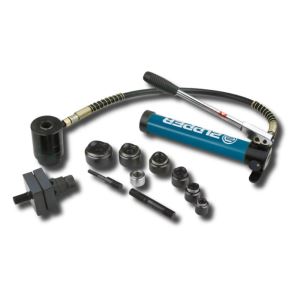
The CH-70 is delivered with a complete set of high-carbon, heat-treated steel dies designed for standard industrial metric bolts. The standard inventory includes: 10.5mm, 13.8mm, 17mm, 20.5mm.
The CH-70 is a dedicated heavy-duty fabrication head without an internal fluid reservoir. To generate the required 350KN shearing force and penetrate 10mm metal safely, it must be paired with an external 700-bar (10,000 psi) hydraulic power unit. Based on your specific production environment, we suggest the following two operational configurations:
For continuous workshop production: Zupper TEP-700B Electric Hydraulic Pump We strictly mandate pairing the CH-70 with the TEP-700B for panel building facilities executing high-volume batch processing on heavy-gauge materials. This electric power unit delivers rapid, consistent fluid displacement to minimize punch cycle times through thick steel. It features a remote foot-pedal actuator, which is a critical safety requirement; it allows the operator to maintain two-handed mechanical control over the heavy 10mm workpiece for exact center-mark alignment before initiating the 35-ton shear.

For localized field deployment: Zupper CP-700 Manual Hydraulic Pump For deployment in remote substations or heavy maintenance environments lacking a stable electrical grid, the CH-70 must be operated via the CP-700 manual pump. Engineered with a dual-stage fluid displacement mechanism, this manual unit efficiently builds the required 700-bar pressure to shear 10mm metal. It ensures field technicians can execute precise punching operations completely independent of external power sources.

Asia Pro Equip supplies verified, heavy-duty fabrication solutions to the mechanical engineering, switchgear manufacturing, and civil construction sectors. We maintain strategic, ready-to-deploy inventory of the Zupper CH-70 puncher and its associated tooling configurations within our regional logistics hubs, ensuring efficient supply chain fulfillment to industrial zones across Singapore and Malaysia.
Operating on a strictly transparent B2B pricing model, our technical sales division is prepared to process your official RFQ, verify equipment compliances against your local engineering specifications, and fulfill your operational requirements.
Corporate Sales & RFQ: [email protected]
| Technical Parameter | Metric Value |
| Model | Zupper CH-70 |
| Tool classification | Single-acting hydraulic hole puncher |
| Maximum rated load capacity | 35 Ton (350 KN) |
| Throat depth (Clearance) | 110 mm |
| Max material thickness (All metals) | 10 mm |
| Rated fluid pressure requirement | 700 bar (10,000 psi) |
| Net weight | 35.0 kg |
Standard tooling configuration:
The CH-70 is delivered with a complete set of high-carbon, heat-treated steel dies designed for standard industrial metric bolts. The standard inventory includes: 10.5mm, 13.8mm, 17mm, 20.5mm.
Find answers to common inquiries about our power tools and professional services
Address:
Phone: +65 8914 6529
Email: [email protected]

All prices are listed in USD and exclude local taxes (such as GST/SST).
Final billing may be converted to SGD or MYR based on prevailing exchange rates at the time of formal quotation.
asiaproequip.com - 2026