 English


Your cart
0 items
Shopping cart is empty (0 item)
English
Across the rapidly expanding industrial corridors of Singapore and Malaysia, corporate procurement analytics indicate a massive 70% surge in demand for resources related to "Equipment Engineers." This exponential growth is directly tied to the region's aggressive expansion in semiconductor foundries, hyper-scale data centers, petrochemical refineries, and highly automated manufacturing plants.
Within these high-stakes environments, the operational heartbeat of a multi-billion-dollar facility rests squarely on the shoulders of the equipment engineering division. These highly specialized professionals do not deal in abstract theoretical designs; they operate on the unforgiving front lines of industrial reality. Their core mandates encompass the physical installation of monolithic CNC machining centers, the execution of precision structural modifications on aging factory lines, and the flawless integration of high-voltage power grids during critical, time-sensitive plant shutdowns.
However, the modern industrial landscape has introduced a severe logistical nightmare: factory floors are becoming infinitely denser, industrial machinery is becoming exponentially heavier, and the spatial clearance available for maintenance is shrinking to absolute minimums. To execute their duties flawlessly while strictly adhering to Workplace Safety and Health (WSH) regulations, equipment engineers can no longer rely on standard, consumer-grade tools. They require an elite, extreme-duty tooling arsenal designed explicitly for confined spaces, absolute micro-metric precision, and uncompromising structural safety.
The foundational—and arguably the most hazardous—task assigned to an equipment engineering team is the uncrating, moving, and permanent installation of heavy industrial machinery. Consider the logistics of installing a 20-ton injection molding machine or a highly sensitive photolithography stepper.
These monolithic structures are delivered completely flush against the concrete factory floor. They represent a massive, concentrated dead load (the static weight of the machine itself). If a machine of this magnitude is not perfectly leveled to microscopic tolerances upon installation, the internal moving components will suffer from severe asymmetrical stress. Over time, this leads to aggressive vibration, premature bearing failure, and ultimately, catastrophic fatigue failure of the machine's structural chassis.
The immediate engineering challenge is zero-clearance. Standard hydraulic lifting equipment, such as traditional bottle jacks or heavy-duty cylinders, typically require a minimum vertical insertion clearance of 100mm to 200mm. When a 20-ton machine chassis sits perfectly flush on a concrete slab, inserting a standard cylinder beneath it is geometrically impossible. Attempting to lift the machine from the top using overhead gantry cranes introduces the risk of dangerous load-swing and can severely warp the fragile external casing of precision equipment. The lift must be initiated from the absolute bottom edge.
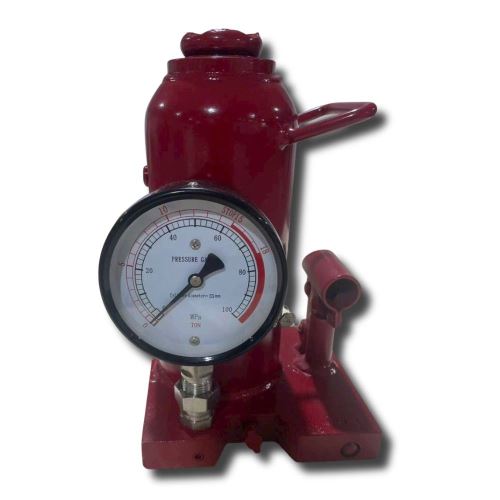
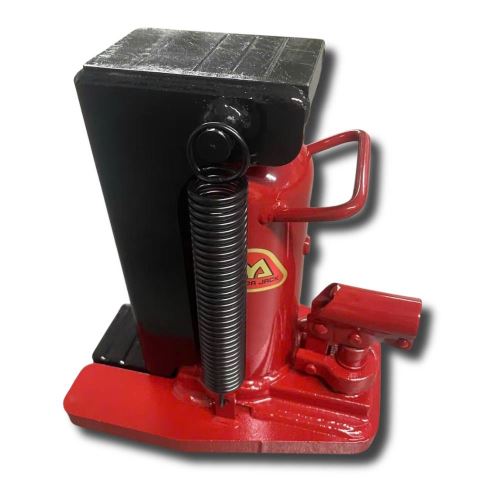
To overcome the paradox of flush-mounted machinery, the industry exclusively relies on a highly specialized piece of lifting equipment: the hydraulic toe jack. In this rigorous arena, Japanese hydraulic engineering remains entirely uncontested, with the Masada MHC-10RS-2 Toe Jack serving as the absolute gold standard for professional equipment engineers across Southeast Asia.
The Masada MHC-10RS-2 is a masterpiece of fluid-dynamic engineering. It is uniquely designed with a heavy-duty, low-profile lifting "toe" forged from high-yield steel, located at the absolute base of the cylinder, resting just 28mm off the ground. Concurrently, it features a standard lifting "head" at the top of the piston. This dual-architecture provides two distinct lifting capacities: a massive 20-Ton capacity on the head, and a highly concentrated 10-Ton capacity on the toe.
This allows the rigging crew to slide the thin 28mm steel toe directly into the microscopic gap between the heavy machinery and the factory floor. By engaging the pump, the engineer applies localized hydraulic force to overcome the dead load, elevating the machinery just enough to slide heavy-duty transportation skates or permanent leveling blocks underneath.
What elevates the MHC-10RS-2 from a standard lifting tool to a mandatory piece of shutdown equipment is the inclusion of the Return Spring (RS). In standard toe jacks, once the machine is lifted and blocked, the hydraulic fluid is released. However, without a load pressing down on the toe, the internal piston often remains extended. The engineer is forced to manually jump on the toe or use a heavy pry bar to force the piston back down into the cylinder—a highly exhausting and dangerous act in a confined space.
The MHC-10RS-2 completely eliminates this manual labor. Engineered with a pair of heavy-duty external return springs, the millisecond the engineer opens the pressure release valve, the high-tension springs automatically and forcefully retract the piston, driving the hydraulic fluid back into the reservoir. In a high-stakes factory shutdown where every minute of downtime costs thousands of dollars, this automatic rapid-retraction feature preserves the engineer's physical stamina and drastically accelerates the machinery moving process.
Industrial machines are frequently installed tight against structural walls or inside narrow production trenches. The Masada hydraulic toe jack MHC-10RS-2 accommodates these spatial restrictions via a 180-degree rotating handle socket. The engineer can position the jack under the machine, rotate the pumping socket entirely to the side, and safely actuate the hydraulic lever from an offset, ergonomic position, ensuring they are never forced to stand directly in the dangerous pinch-point zone.

Once the Masada toe jacks have elevated the machine and temporary cribbing is in place, the macro-lifting phase concludes. The equipment engineer must now execute micro-precision leveling. The massive dead load must be distributed with absolute mathematical equality across the machine's foundation to prevent future structural vibration and material fatigue.
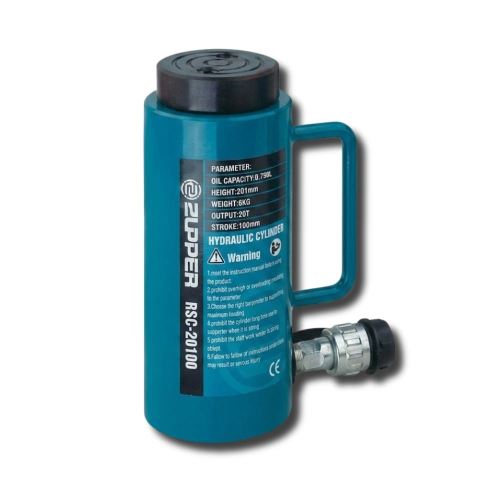
For this delicate operation, engineers transition from toe jacks to Low-Profile Hydraulic Cylinders (such as the Zupper RC Series).
Engineered with an ultra-flat, disk-like architecture, these cylinders easily slide into the tight gaps beneath the elevated machine frame. Operating these cylinders requires strict adherence to the laws of hydraulic safety: low-profile jacks are mathematically restricted to a maximum mechanical stroke of just 20mm. Attempting to push a high-tonnage load beyond a 20mm stroke in a low-profile housing compromises the internal seal overlap, risking a catastrophic blowout.
By utilizing external manual hand pumps connected via high-pressure hoses, the equipment engineer can actuate the Zupper RC cylinders from a safe distance. This remote operation allows them to make microscopic, millimeter-by-millimeter vertical adjustments across all four corners of the machine. The engineer carefully monitors spirit levels and laser alignment tools, ensuring the structural dead load is perfectly balanced before the permanent anchor bolts are grouted into the concrete foundation.
The installation of a new industrial machine rarely matches the existing structural layout of a legacy factory. Equipment engineers are perpetually tasked with modifying the physical environment to accommodate new technology. This routinely requires drilling large-diameter penetrations through massive carbon steel H-beams, structural gussets, or the machine chassis itself to run new mechanical conduits or bolt down heavy structural supports.
In a fabrication shop, this heavy drilling is executed on a massive, stationary drill press. On a congested factory floor, the tool must be brought to the workpiece. However, traditional vertical magnetic drills feature towering motor housings and extended vertical carriage tracks. They are physically impossible to insert into the congested undercarriage of heavy machinery, inside narrow box girders, or between densely packed pipe racks.
When structural modifications must be executed inside these highly confined spatial envelopes, the Cayken KCY-38DM low profile magnetic drill is the engineer's ultimate solution.
By entirely reconfiguring the electromechanical architecture, Cayken engineers mounted the devastatingly potent 1650W drive motor horizontally, perfectly parallel to the electromagnetic base. This ultra-compact geometry drastically reduces the overall operating height of the equipment, allowing it to seamlessly slip into the narrowest steel channels.

Traditional magnetic drills utilize a large three-spoke rotary handle to advance the motor—a design that requires 360 degrees of unobstructed spatial clearance. The Cayken KCY-38DM completely reinvents this mechanical interaction by utilizing a heavy-duty, quick-release ratchet lever.
This specialized ratcheting mechanism allows the equipment engineer to advance a 38mm Weldon-shank annular cutter through thick structural steel using highly restricted, micro-movements of the handle. The operator can stroke the handle just a few degrees at a time to apply massive downward cutting pressure. Supported by a high-flux electromagnetic base generating 11,500 Newtons of holding force, the drill remains absolutely immobilized, guaranteeing that the brittle annular cutter does not bind or shatter while executing flawlessly concentric holes in the tightest corners of the plant.
The mechanical installation and structural modification of a machine represent only the physical aspect of an engineer's duty. A multi-million-dollar CNC center is fundamentally useless until it is seamlessly integrated into the facility's high-voltage power grid.
Equipment engineers and their specialized electrical divisions must terminate massive, heavy-gauge copper cables inside densely packed main distribution boards (MDBs) and the narrow control cabinets of the machinery. Standard electrical termination methods utilize bulky, pistol-grip hydraulic crimpers. When an engineer attempts to force a perpendicular pistol-grip tool into a congested switchgear full of live busbars, it frequently leads to improper die alignment. A crooked crimp results in a structurally compromised, high-resistance electrical joint. Under continuous industrial loads, these poor connections suffer from thermal runaway, ultimately triggering catastrophic electrical fires.
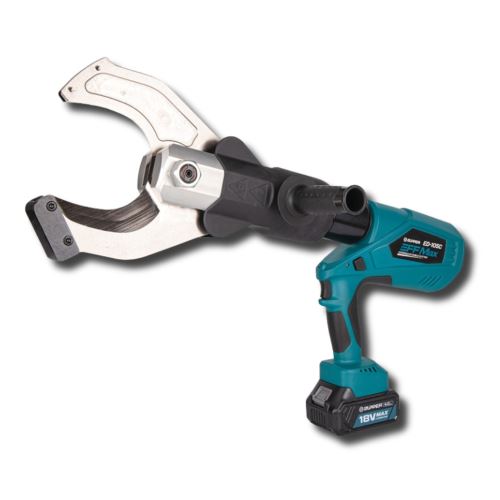
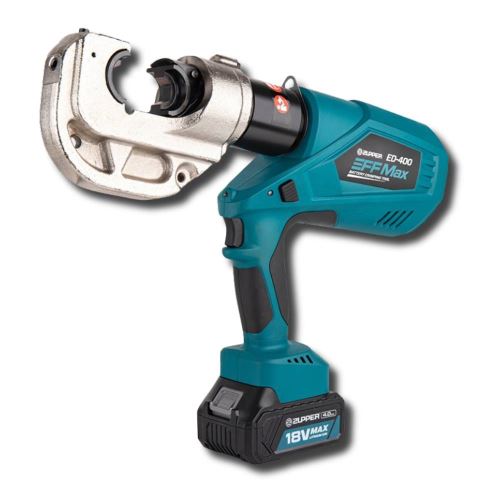
To navigate these highly restricted electrical corridors without compromising the integrity of the termination, engineers deploy specialized Inline Battery Hydraulic Crimpers, primarily the Zupper SL-240.
Engineered for extreme mobility, the SL-240 weighs strictly 3.0 kg and features a streamlined vertical axis (stick-type design). The drive motor, the hydraulic pumping mechanism, and the crimping head are aligned perfectly straight, eliminating the bulky side profile entirely. This allows the electrical engineer to effortlessly slide the tool deep into the narrowest switchgear cavities.
Operating on an 18V lithium-ion platform, the SL-240 generates a devastating 50kN of electromechanical compression force. This immense pressure physically crushes the metallic structure of the lug, forcing the internal copper strands to deform and bind together in a process known as cold-welding. Because the process relies entirely on fluid-dynamic compression rather than heat, it is completely arc-free and generates zero sparks. With absolute one-handed control, the equipment engineer can execute flawless, gas-tight cold-welds on copper cables up to 240mm2, ensuring maximum electrical conductivity and strict compliance with the highest international electrical safety codes.

Providing an engineering fleet with world-class equipment is insufficient without the rigorous enforcement of Standard Operating Procedures. When dealing with extreme hydraulic forces and heavy structural loads, deviation from safety protocols results in catastrophic facility damage.
Toe Jack Load Centering: When deploying the Masada MHC-10RS-2, the engineer must ensure the 28mm toe is fully inserted beneath the load. Lifting a machine with only the outer edge of the toe induces severe bending momentum, which can permanently deform the high-yield steel toe and cause the load to slip.
Magnetic Drill Tethering: When operating the Cayken KCY-38DM in an inverted or horizontal position within a steel structure, the 11,500N electromagnet provides immense holding force. However, engineers must mandate the use of a high-tensile safety chain. A sudden, localized power outage will instantly kill the electromagnet; the tether prevents the heavy drill from plummeting onto personnel below.
Crimping Die Verification: Before actuating the Zupper SL-240, the operator must mathematically verify that the selected hexagonal dies perfectly match the cross-sectional area of the copper cable (e.g., using a 240mm2 die for a 240mm2 cable). Undersized dies will violently jam the hydraulic jaw, while oversized dies will fail to achieve a proper cold-weld, resulting in a dangerous, loose connection.
The overall efficiency, safety record, and emergency-response capability of an industrial maintenance division are directly proportional to the quality and specificity of their diagnostic and mechanical tooling. Relying on makeshift lifting solutions, standard-profile drills in confined spaces, or manual crimpers for high-voltage cables inevitably leads to massive plant downtime and severe WSH violations.
For corporate procurement officers and facility directors, outfitting your equipment engineering teams with an integrated arsenal of specialized B2B tools is not an expense; it is a critical operational investment. By integrating the rapid-retraction capabilities of the Masada MHC-10RS-2 Toe Jack, the zero-clearance drilling power of the Cayken KCY-38DM, and the inline electromechanical precision of the Zupper SL-240 Crimper, you guarantee that your engineering fleet is fully prepared to conquer any installation, modification, or electrical termination challenge.
At Asia Pro Equip, we understand the relentless demands placed upon equipment engineers. We meticulously maintain a strategic, ready-to-deploy physical inventory of these extreme-duty industrial solutions within our regional logistics hubs. Our technical sales division is fully prepared to verify equipment specifications against your facility's unique operational needs, ensuring rapid supply chain fulfillment directly to your manufacturing plant, shipyard, or petrochemical facility across Singapore and Malaysia.
Empower your equipment engineers with the specialized arsenal they require to keep the mechanical heart of your industry beating without interruption.
Corporate Procurement & Technical Inquiries: [email protected]
Find answers to common inquiries about our power tools and professional services
Address:
Phone: +65 8914 6529
Email: [email protected]

All prices are listed in USD and exclude local taxes (such as GST/SST).
Final billing may be converted to SGD or MYR based on prevailing exchange rates at the time of formal quotation.
asiaproequip.com - 2026