 English


Your cart
0 items
Shopping cart is empty (0 item)
English
The industrial landscape across Singapore and Malaysia is currently undergoing a massive phase of modernization and expansion. From the relentless development of deep underground MRT infrastructure and highly automated mega-ports to the continuous upgrading of advanced semiconductor foundries, the physical scale of engineering projects is reaching unprecedented levels. Within these critical sectors, structural contractors, civil engineers, and heavy machinery mechanics are consistently confronted with a logistical inevitability: the manipulation of extreme structural payloads.
When tasked with executing bridge bearing replacements, leveling 50-ton CNC machining centers, or executing structural modifications within the highly confined hull of a commercial vessel, standard mechanical jacks and consumer-grade lifting tools are entirely obsolete. They lack the structural integrity and the mechanical force required to ensure Workplace Safety and Health (WSH) compliance. This escalating demand for safe, unyielding, and micro-metric vertical elevation has driven a significant surge in the reliance on high-tonnage industrial hydraulic cylinders.
Understanding the physics, selection criteria, and strict operating procedures of these specialized fluid-dynamic tools is no longer optional for corporate procurement officers and site engineers - it is a mandatory requirement for operational success and on-site safety.
To deploy lifting equipment effectively, engineering teams must first understand the fundamental physical principles that govern extreme-force hydraulics. An industrial hydraulic cylinder is not a standalone machine; it is a highly calibrated mechanical actuator designed to convert fluid pressure into immense, controlled kinetic energy.
A critical and often misunderstood reality of heavy-duty hydraulic lifting is the method of power generation. High-tonnage industrial hydraulic cylinders do not - and cannot - utilize internal battery power. Relying on fragile internal lithium-ion circuit boards to sustain a massive suspended concrete girder is a severe WSH violation. Internal batteries introduce dangerous thermal failure points and are physically incapable of sustaining the continuous, high-volume fluid displacement required to lift 50 or 100 tons safely.
Instead, true industrial lifting cylinders operate strictly via robust, external fluid delivery systems. The cylinder is driven by high-pressure hydraulic oil, universally standardized at 10,000 PSI (700 Bar). This pressurized fluid must be generated by independent manual hydraulic hand pumps (such as the Zupper CP-700) or heavy-duty electric-driven hydraulic pumps. By strictly separating the power generation (the external pump) from the lifting actuator (the cylinder), engineers can remotely execute the lift from a safe distance, maintaining absolute micro-metric control over the fluid flow without exposing their bodies to the immediate drop zone.

The most widely deployed architecture in structural engineering is the Single-Acting Hydraulic Cylinder. In this design, the external pump forces hydraulic fluid into the lower chamber, driving the heavy steel piston upward to lift the payload. However, once the fluid pressure is released, the piston must return to its base position.
Load Return: Basic cylinders require the physical weight of the load to push the piston back down.
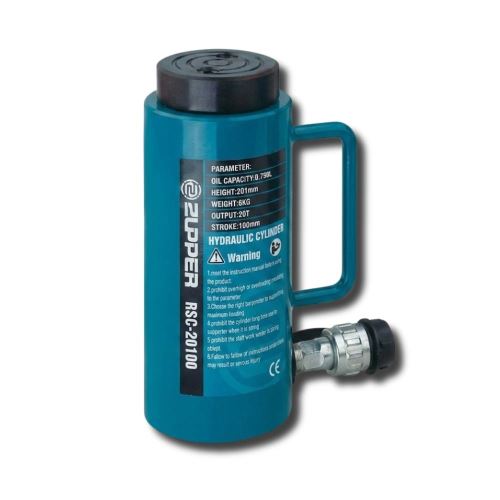
Spring Return: Premium industrial cylinders, such as the Zupper RSC series, integrate a heavy-duty internal retraction spring. The millisecond the external pump valve is opened, this high-tension spring forcefully retracts the piston, driving the oil back into the pump reservoir. This automated retraction drastically accelerates plant shutdown maintenance and eliminates the dangerous need for operators to manually force the cylinder down in confined spaces.

The versatility of the hydraulic cylinder makes it the undisputed cornerstone of modern industrial maintenance and construction. Its applications span across three primary heavy-duty sectors:
In advanced manufacturing facilities, installing a monolithic injection molding machine requires absolute precision. The machinery must be leveled to microscopic tolerances to prevent asymmetrical stress and catastrophic vibration fatigue. Engineers utilize specialized hydraulic cylinders to elevate the machine chassis fractions of a millimeter at a time, allowing for the precise insertion of permanent vibration-dampening leveling mounts.
Highway overpasses and transit bridges are subjected to massive dynamic traffic loads, requiring periodic replacement of their elastomeric bearing pads. Civil engineering crews deploy synchronized arrays of high-capacity hydraulic cylinders to simultaneously lift massive precast concrete bridge decks. This requires extended-stroke cylinders that can provide sustained, continuous elevation without the need to constantly pause and reset the lifting equipment.
Inside the cramped, unyielding steel hull of a commercial vessel, spatial clearance is virtually non-existent. Maritime engineers rely on heavy-duty hydraulic cylinders to align massive propeller shafts, mount diesel engine blocks, and reshape deformed structural bulkheads. The ability to generate 50 tons of localized force in an area where a crane cannot reach is invaluable to shipyard efficiency.
Selecting the incorrect hydraulic cylinder for a critical lift leads to catastrophic equipment failure, severe WSH penalties, and potential loss of life. Procurement officers must evaluate three non-negotiable parameters:
Never procure a cylinder whose maximum capacity exactly matches your payload. If you are lifting a 20-ton structural module, utilizing a 20-ton jack pushes the internal seals to their absolute maximum threshold, leaving zero room for unexpected weight shifts or friction binding. The golden rule of industrial rigging is to mandate a 20% to 30% safety buffer. For a 20-ton load, engineers should deploy a minimum 30-ton or 50-ton cylinder. This ensures the hydraulic seals operate comfortably within their stress limits, guaranteeing a smooth, linear lift.
The "stroke" is the maximum distance the internal piston can extend. For open-air civil engineering tasks where vertical clearance is abundant, deploying an extended-stroke cylinder—such as the Zupper RSC series offering a 100mm continuous stroke—is highly recommended. An extended stroke allows the crew to lift the payload to the final working height in one uninterrupted fluid motion, eliminating the dangerous practice of stopping midway to insert temporary cribbing and resetting the jack.
When working in confined spaces, such as lifting machinery resting flush against a factory floor, engineers must transition to Low-Profile Hydraulic Cylinders. These ultra-flat cylinders are designed to slide into microscopic structural gaps.
However, there is an absolute, non-negotiable law of fluid-dynamic engineering regarding low-profile equipment: The maximum safe operating stroke for a heavy-duty low-profile cylinder is strictly limited to 20mm. Attempting to design or utilize a low-profile cylinder with a stroke exceeding 20mm compromises the internal structural overlap between the piston and the cylinder wall. Under extreme tonnage, any lateral load shift will cause an over-extended low-profile piston to violently blow out the side of the housing. Always strictly adhere to the 20mm parameter when operating in confined envelopes.
Possessing world-class hydraulic equipment is insufficient without the rigorous enforcement of structural safety protocols. All industrial lifting operations must mandate the following SOPs:
Pre-Operation Diagnostics: Before connecting the external pump, technicians must visually inspect the 3/8 NPT quick-couplers for debris and ensure the high-pressure hydraulic hoses show no signs of abrasion or internal wire mesh exposure. A blown hose at 10,000 PSI is a lethal hazard.
Absolute Load Centering: Hydraulic cylinders are mathematically engineered to handle immense vertical compressive forces, but they are highly vulnerable to lateral (side) loading. The payload must be perfectly centered over the principal axis (the saddle) of the jack. Off-center loading will instantly score the internal cylinder walls, destroy the hydraulic seals, and cause an immediate, catastrophic pressure loss.
Foundation Verification: Never deploy a hydraulic cylinder directly onto soft soil, asphalt, or compromised concrete. The extreme point-load generated by the base of the cylinder will punch directly through weak surfaces, causing the load to instantly topple. Always utilize heavy-duty steel distribution plates to spread the kinetic force over a wider structural area.
The "Lift and Block" Mandate: Hydraulic pressure is a temporary lifting force, not a permanent structural support. You must never allow a suspended load to rest entirely on the hydraulic pressure of a cylinder for extended periods. As the cylinder elevates the load, operators must continuously insert mechanical cribbing (hardwood blocks or engineered steel pillars) beneath the payload. If a hydraulic seal were to fail, the load immediately settles onto the mechanical cribbing, preventing a disaster.
For corporate procurement divisions, project managers, and facility directors across Singapore and Malaysia, sourcing critical hydraulic lifting equipment requires a partner who understands the severe demands of industrial engineering. Approaching lifting equipment as a series of isolated purchases from retail hardware shops is highly inefficient and compromises on-site safety.
Asia Pro Equip (A.P.E) is the region’s premier distributor of highly verified, extreme-duty industrial tooling. We specialize in providing comprehensive, strategically integrated lifting ecosystems.
We meticulously maintain a strategic, ready-to-deploy physical inventory of premium hydraulic cylinders - including extended-stroke models for infrastructure elevation and strict 20mm low-profile cylinders for confined space leveling. Furthermore, we supply the mandatory high-pressure manual and electric external pumps required to drive these heavy-duty actuators safely.
Operating on a transparent, highly competitive pricing model, our technical engineering division is fully prepared to consult on your specific payload requirements. We will meticulously verify equipment specifications, calculate safety buffers, and ensure flawless supply chain fulfillment directly to your elevated construction site, commercial shipyard, or petrochemical facility.
Ensure every heavy load is managed with absolute precision and unyielding structural safety.
Corporate Procurement & Technical Inquiries: [email protected]
Find answers to common inquiries about our power tools and professional services
Address:
Phone: +65 8914 6529
Email: [email protected]

All prices are listed in USD and exclude local taxes (such as GST/SST).
Final billing may be converted to SGD or MYR based on prevailing exchange rates at the time of formal quotation.
asiaproequip.com - 2026