 English


Your cart
0 items
Shopping cart is empty (0 item)
English
When procurement analytics indicate a massive surge in regional demand for "laboratory equipment," the conventional assumption leans heavily toward biomedical devices, chemical fume hoods, or microscopic diagnostics. However, within Singapore and Malaysia’s rapidly expanding heavy infrastructure, maritime engineering, and advanced manufacturing sectors, "laboratory equipment" carries an entirely different, intensely industrial definition.
For structural engineers, university research facilities, and government-certified materials testing laboratories, the most critical diagnostic equipment is not found on a delicate workbench. It is installed within heavy-duty testing bays and massive load frames where concrete cubes are systematically crushed, bridge girders are stressed to their absolute breaking points, and industrial polymers undergo grueling endurance trials.
The undisputed core of these destructive and non-destructive materials testing machines is completely fluid-dynamic. Precision hydraulic jacks and specialized cylinders are the invisible engines driving modern structural research. To guarantee that the concrete and steel utilized in Singapore and Malaysia’s MRT tunnels or high-rise foundations perform exactly as mathematically predicted, laboratories require lifting and pressing equipment that transcends standard construction jacks. They require highly calibrated, zero-tolerance scientific instruments.
Before selecting the appropriate hydraulic equipment for a testing facility, one must understand the fundamental physical forces materials are subjected to during certification. Structural materials do not simply "break"; they yield, deform, and fail under highly specific, measurable conditions.
In heavy infrastructure, structural components are rarely subjected to a single, simple load. They endure complex, multidirectional forces over decades. A suspension bridge, for example, is constantly battered by dynamic traffic loads, thermal expansion, and extreme wind sheer. To replicate these real-world stresses within a controlled environment, civil engineering laboratories execute highly specialized protocols, most notably Fatigue Testing.
Fatigue Testing is the rigorous process of applying repetitive, cyclical stress to a material sample to observe how microscopic internal fractures develop over time. Unlike a simple ultimate-yield test that crushes a sample instantly, fatigue testing seeks to establish the Fatigue Strength - the maximum stress a material can withstand for a specific number of cycles without failing. Furthermore, engineers utilize these tests to pinpoint the Endurance Limit, which is the precise stress amplitude below which the material can theoretically endure an infinite number of load cycles without suffering fatigue failure.
Replicating these immense, cyclical forces requires hydraulic equipment capable of delivering exact, quantifiable, and repeatable mechanical output.
In a certified structural laboratory, applying massive kinetic force to a material sample is functionally useless if that force cannot be meticulously quantified and recorded. When evaluating a new, high-density concrete batch, engineers must know the exact metric tonnage or kN reading at the precise millisecond the structural matrix catastrophically fails.
Standard hydraulic jacks are engineered solely to lift loads; they provide zero feedback to the operator regarding the internal pressure being exerted. To achieve scientific measurement, testing facilities must integrate specialized hydraulic equipment designed for active load monitoring.
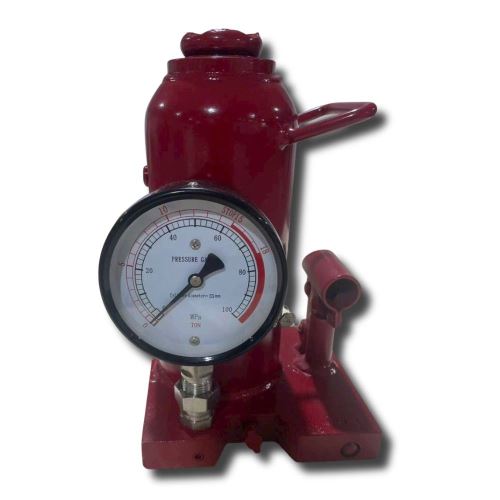
For structural laboratories demanding zero-tolerance precision, the Masada Hydraulic Jack with Pressure Gauge stands as the ultimate industry benchmark. Manufactured with uncompromising Japanese metallurgy and internal valve precision, this specialized platform integrates a highly calibrated analog or digital pressure gauge directly into the hydraulic manifold.
As the operator engages the pumping mechanism, driving the piston against the material sample, the integrated gauge actively measures the internal hydraulic fluid pressure (typically displayed in Bar, PSI, or direct Metric Tons). This real-time data acquisition is critical. It allows laboratory technicians to apply a highly controlled, incremental load, generating the precise stress-strain curves required for international safety certifications (such as ISO or ASTM standards). Without the integration of highly accurate pressure monitoring, a hydraulic cylinder is merely a lifting tool; equipped with a Masada pressure gauge, it becomes an indispensable diagnostic instrument.

The most common application for gauge-equipped hydraulic jacks in civil engineering is the Push – Flex Bend/ Compression test.
During a compression test, a concrete cylinder or cube is placed between the heavy steel platens of a testing frame. The Masada gauge-equipped jack applies steady, relentless upward or downward compressive force. The technician monitors the gauge as the pressure climbs, noting the exact value when the concrete structurally shatters.
Similarly, in a flex bend test, a structural beam (concrete or steel) is supported at both ends while the hydraulic jack applies concentrated downward force directly to the center span. The integrated gauge allows engineers to monitor the exact applied load while simultaneously measuring the beam's deflection (bending) until it reaches its structural yield point. The flawless internal seals of the Masada jack ensure that the pressure increases smoothly and linearly, preventing erratic pressure spikes that could corrupt the test data.
While compression tests evaluate a material's resistance to crushing, a Pull – Tensile Fatigue Test evaluates a material's resistance to being torn apart. This is paramount for testing elevator cables, suspension bridge wire ropes, and high-tensile structural bolts.
In tensile fatigue testing, the material sample is gripped securely at both ends within a heavy-duty load frame. Specialized hydraulic setups (often involving hollow-plunger cylinders pulling a tension rod) are utilized to apply massive, repetitive pulling forces. The objective is to repeatedly stretch and relax the material, evaluating its behavior under cyclical tension.
Establishing the Endurance Limit during a tensile fatigue test is a brutal process that can involve millions of microscopic load cycles. The hydraulic systems driving these load frames must possess exceptional thermal dissipation and internal component durability to survive weeks of continuous, rapid-cycle pressurization and depressurization without suffering catastrophic seal degradation.
While dynamic fatigue testing involves continuous movement, another critical pillar of materials science is static endurance testing. Many structural components must be evaluated based on how they endure massive, unchanging weight over extended periods—sometimes spanning months. This is deeply associated with supporting a Dead load.
A Dead load refers to the intrinsic, constant weight of a structure itself (like the concrete deck of a bridge or the steel framework of a high-rise) that does not move or change over time. When laboratories simulate these conditions, they perform "creep tests" or sustained load testing to observe how materials slowly deform (creep) under permanent, heavy pressure.
Standard hydraulic jacks—even premium models—are fundamentally incapable of executing long-term dead load tests. It is a reality of fluid dynamics that over a period of 48 to 72 hours, microscopic fluctuations in internal check valves or microscopic thermal contraction of the hydraulic fluid will cause the pressure to slowly drop. This phenomenon is known as "hydraulic drift." If a lab is attempting to hold a 50-ton dead load on a structural bearing pad for a month, even a 1% hydraulic drift will completely invalidate the scientific integrity of the entire experiment.
To overcome the severe limitations of fluid dynamics in long-term dead load applications, advanced engineering laboratories must transition from purely hydraulic support to absolute mechanical support.
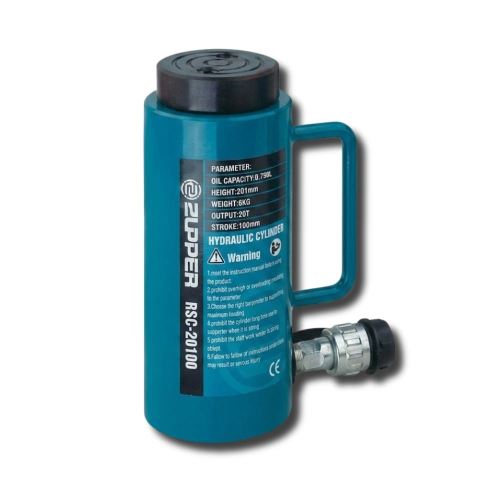
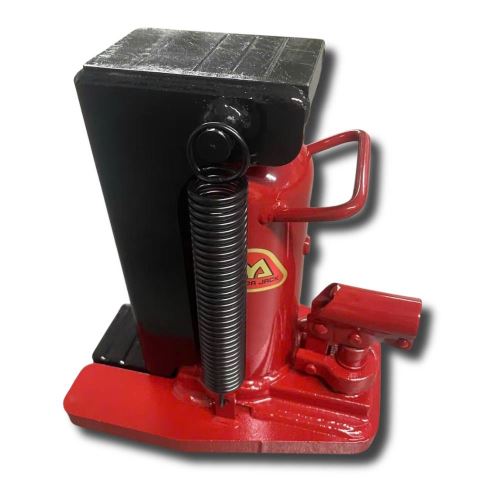
To execute flawless sustained load testing, the integration of the Masada lock nut hydraulic jack is non-negotiable. This highly specialized piece of laboratory equipment bridges the gap between hydraulic lifting power and permanent mechanical stability.
The defining architectural feature of the Masada lock nut jack is its heavily threaded piston exterior and the inclusion of a massive, solid steel mechanical locking collar (the lock nut). The operational procedure for dead load testing is executed as follows:
Hydraulic Pressurization: The technician pumps the hydraulic jack to elevate the testing frame or apply the precise required load (e.g., exactly 100 Tons of simulated dead load) against the material sample.
Mechanical Locking: Once the exact pressure is reached and verified, the operator manually spins the heavy-duty lock nut down the exposed threads of the piston until it sits completely flush against the heavy steel cylinder body.
Pressure Release: The external hydraulic pressure is then completely released via the pump valve.
At this moment, the 100-ton load is no longer supported by pressurized oil; it is physically and permanently supported 100% by the interlocking steel threads of the lock nut. The Masada Lock Nut Hydraulic Jack can hold this massive dead load for weeks, months, or even years with absolute zero millimeter drift. This guarantees the uncorrupted integrity of long-term laboratory creep testing, allowing researchers to accurately map the structural degradation of materials over extreme timelines.

Integrating extreme-force hydraulic systems into a laboratory environment requires strict adherence to safety protocols. A catastrophic failure under a 100-ton load inside a testing facility is a critical hazard.
Calibration Mandates: A gauge-equipped jack is only as reliable as its last calibration. Laboratories must strictly adhere to annual or bi-annual calibration schedules for all pressure gauges and load cells, certifying them against national metrology standards to ensure data validity.
Absolute Load Centering: When executing a push-flex bend test or establishing an endurance limit, the sample must be perfectly centered under the hydraulic ram. Off-center loading induces severe lateral stress (side-loading) on the cylinder, which can instantly score the internal walls, destroy the high-pressure seals, and violently eject the material sample from the testing frame.
Controlled Depressurization: Following a destructive compression test or the conclusion of a dead load trial using a lock nut jack, depressurization must be executed with micro-metric control. Rapidly opening a release valve can cause the heavy testing frame to shock-load the testing bed, causing secondary structural damage to the facility.
For directors of materials testing facilities, university engineering departments, and government infrastructure regulators across Singapore and Malaysia and Malaysia, the accuracy of your testing apparatus dictates the safety of tomorrow's infrastructure. Relying on aging, uncalibrated, or leaking hydraulic components severely compromises your structural data integrity and regulatory compliance.
Upgrading your testing frames with industrial-grade, precision-machined hydraulic solutions is a highly strategic investment. At Asia Pro Equip, we specialize in supplying the absolute pinnacle of Japanese hydraulic engineering to the region's most demanding laboratories.
We meticulously maintain a strategic inventory of highly specialized testing equipment, including the Masada Hydraulic Jack with Pressure Gauge (for active, real-time load monitoring and complex fatigue strength calculations) and the Masada Lock Nut Hydraulic Jack (for unyielding, long-term dead load and sustained endurance testing).
Our technical sales division understands the rigorous demands of civil engineering materials testing. Whether you are outfitting a new ISO-certified concrete testing facility or upgrading the load frames in a maritime research lab, we are fully prepared to verify equipment specifications against your unique diagnostic needs and flawlessly fulfill your operational requirements.
Ensure your structural data is absolute. Contact our technical engineering division today for specialized laboratory lifting and pressing solutions.
Contact our technical engineering division: [email protected]
Find answers to common inquiries about our power tools and professional services
Address:
Phone: +65 8914 6529
Email: [email protected]

All prices are listed in USD and exclude local taxes (such as GST/SST).
Final billing may be converted to SGD or MYR based on prevailing exchange rates at the time of formal quotation.
asiaproequip.com - 2026